ACE Guide Walkthrough

A quick tour of how the VSL ACE Guide works

The ACE Guide puts your ACS standards, FAA handbooks, and regulatory references in one place, and everything is one tap away. Here's how to find your way around.

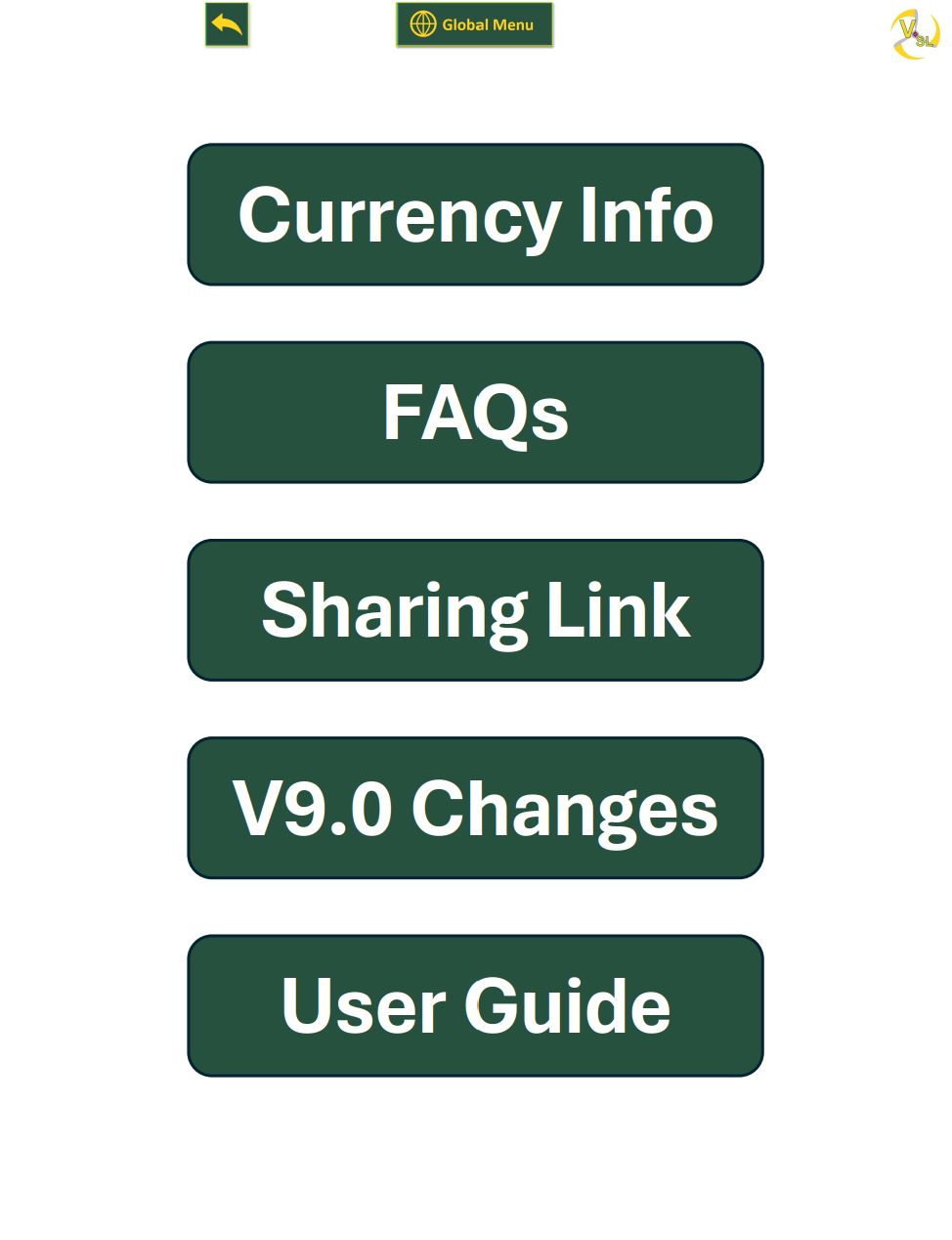
The ACE Guide help menu with buttons for Currency Info, FAQs, Sharing Link, V9.0 Changes, and User Guide

The help menu

At the top right of the Global Menu pages you'll see a "?" button. Tap it to open the help menu.

From there you can get to Currency Info, the FAQs, the Sharing Link, the change log (V9.0 Changes), and the User Guide.

The green help button with a yellow question mark

Look for this button at the top right of each Global Menu page.

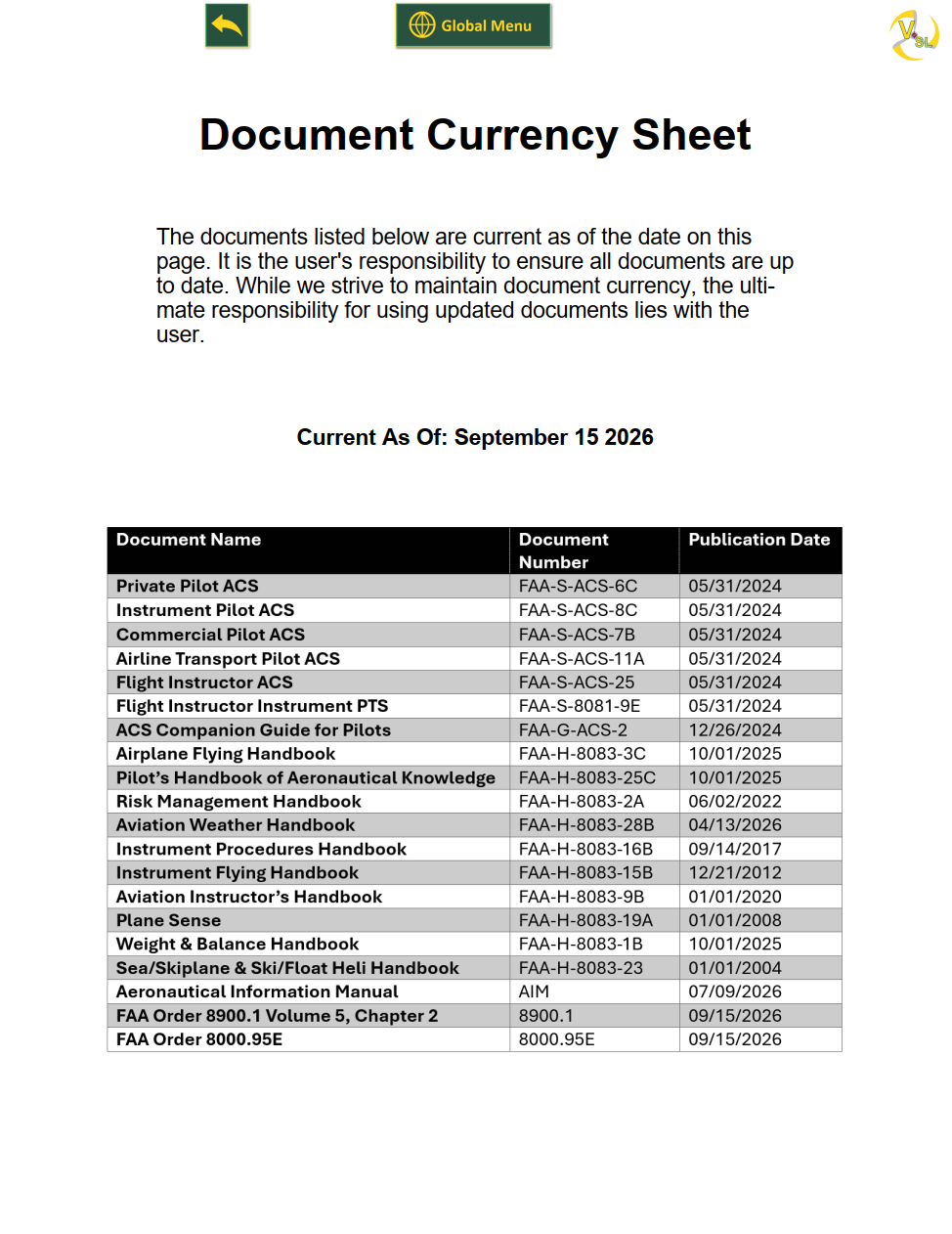
The Document Currency Sheet, a table listing each handbook and ACS document in the guide with its document number and publication date

Currency info

The Currency Info page has a table of the major handbooks and ACS documents in the guide, along with the latest published date for each one.

Compare these dates to the FAA's website to check whether you have the current version.

Your responsibility: the sheet lists the date it was last updated, and reminds you that the ultimate responsibility for using current documents lies with the user.
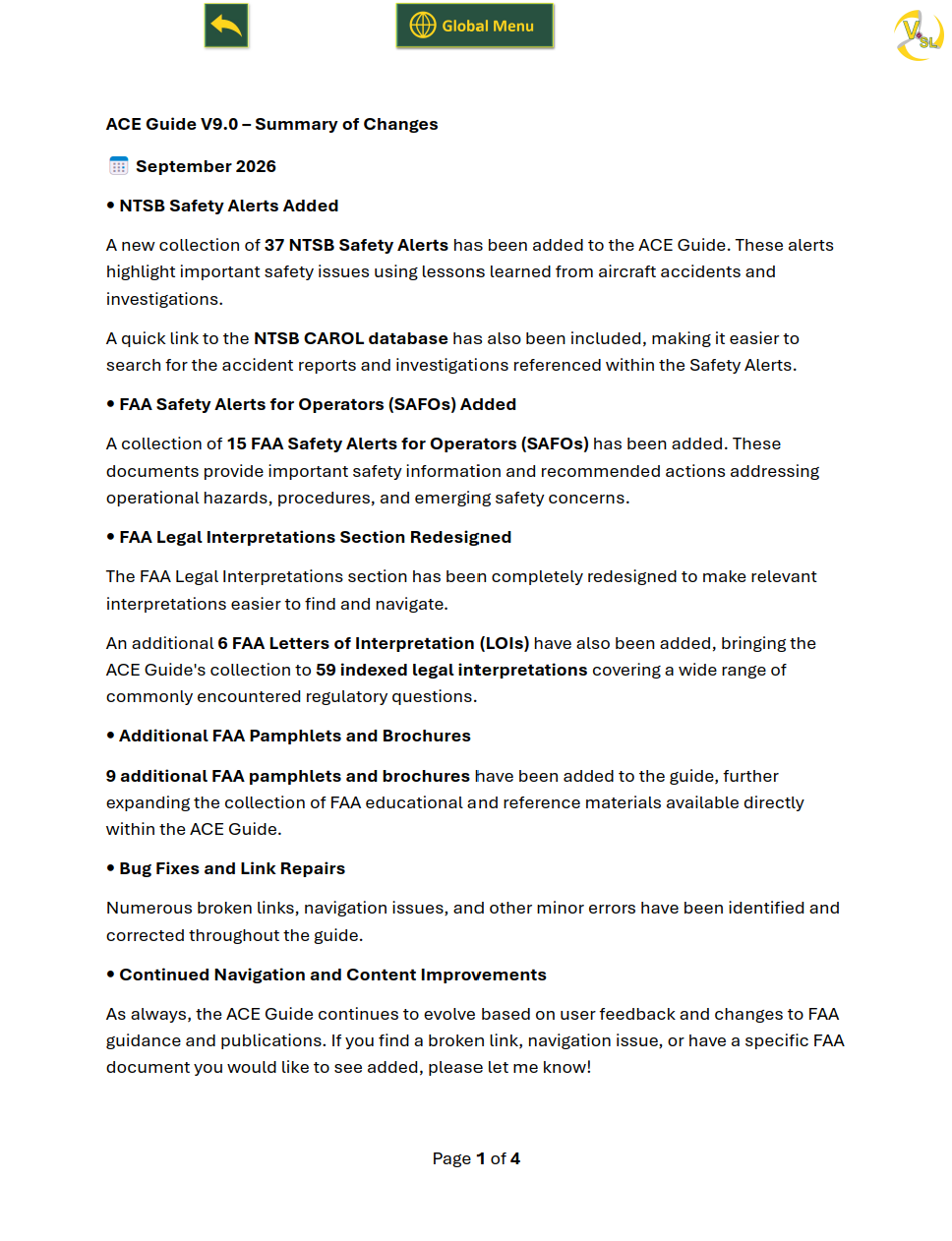
The ACE Guide V9.0 Summary of Changes page, listing what was added and fixed in the September 2026 update

The change log

The V9.0 Changes button (or whatever the current version is) takes you to the change log.

Starting with version 6.9, you can see what has changed in the ACE Guide from one update to the next.

The V9.0 Changes button on the help menu

The button carries the number of the current version, so it will read differently after each update.

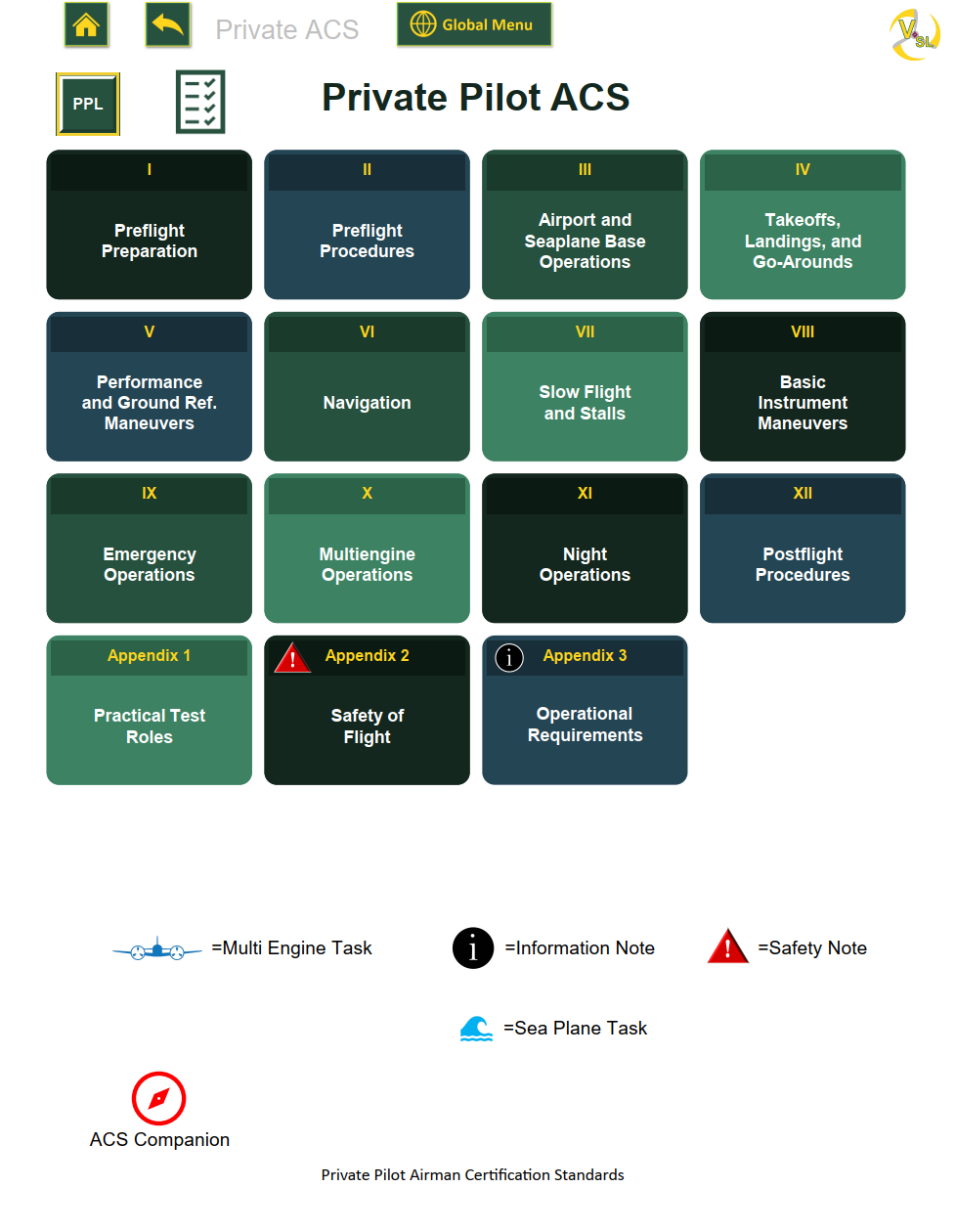
The Private Pilot ACS home page, with a table of contents of tiles for each area of operation and appendix, plus a symbol key and an ACS Companion button at the bottom 1 2 3

Start with the ACS

The most common way to use the guide day to day is to start with the ACS document for the rating you have a question about. Let's look at the Private Pilot ACS.

The home page of each ACS looks very similar. It gives you a table of contents for the ACS, along with some buttons at the bottom of the page.

  1. 1 Table of contents: one tile for each area of operation and appendix.
  2. 2 Symbol key: multiengine task, information note, safety note, and seaplane task.
  3. 3 ACS Companion button.
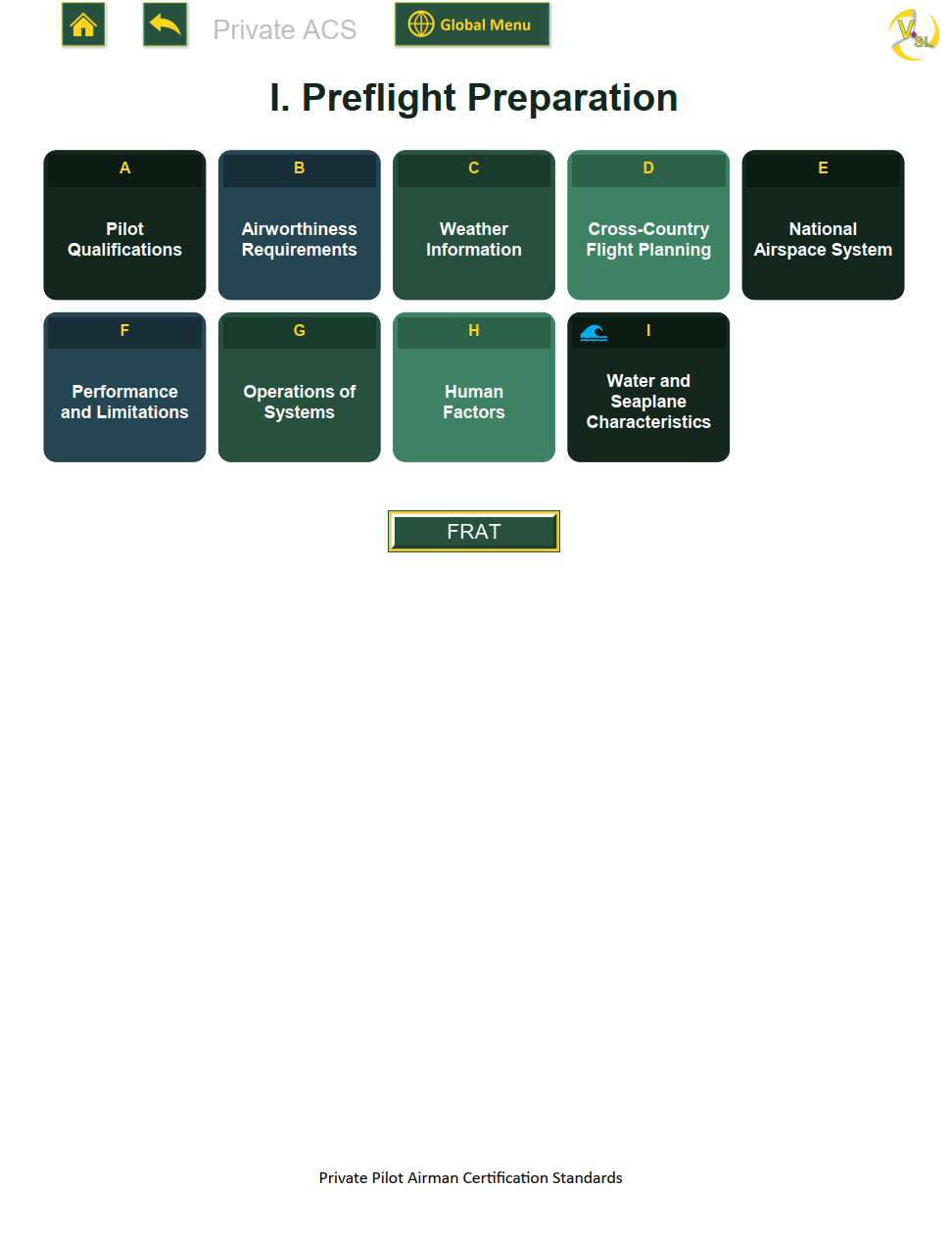
Area of Operation I, Preflight Preparation, showing tiles for Tasks A through I, with Task A, Pilot Qualifications, highlighted

Finding an answer: Area of Operation

Say you have a question about the privileges and limitations of a Private Pilot. We know that information is in Area of Operation I, Preflight Preparation.

After tapping that tile on the ACS home page, you'll find another navigation tree. It includes Task A, Pilot Qualifications.

The Preflight Preparation tile from the Private Pilot ACS home page

Tap this tile on the ACS home page to open Area of Operation I.

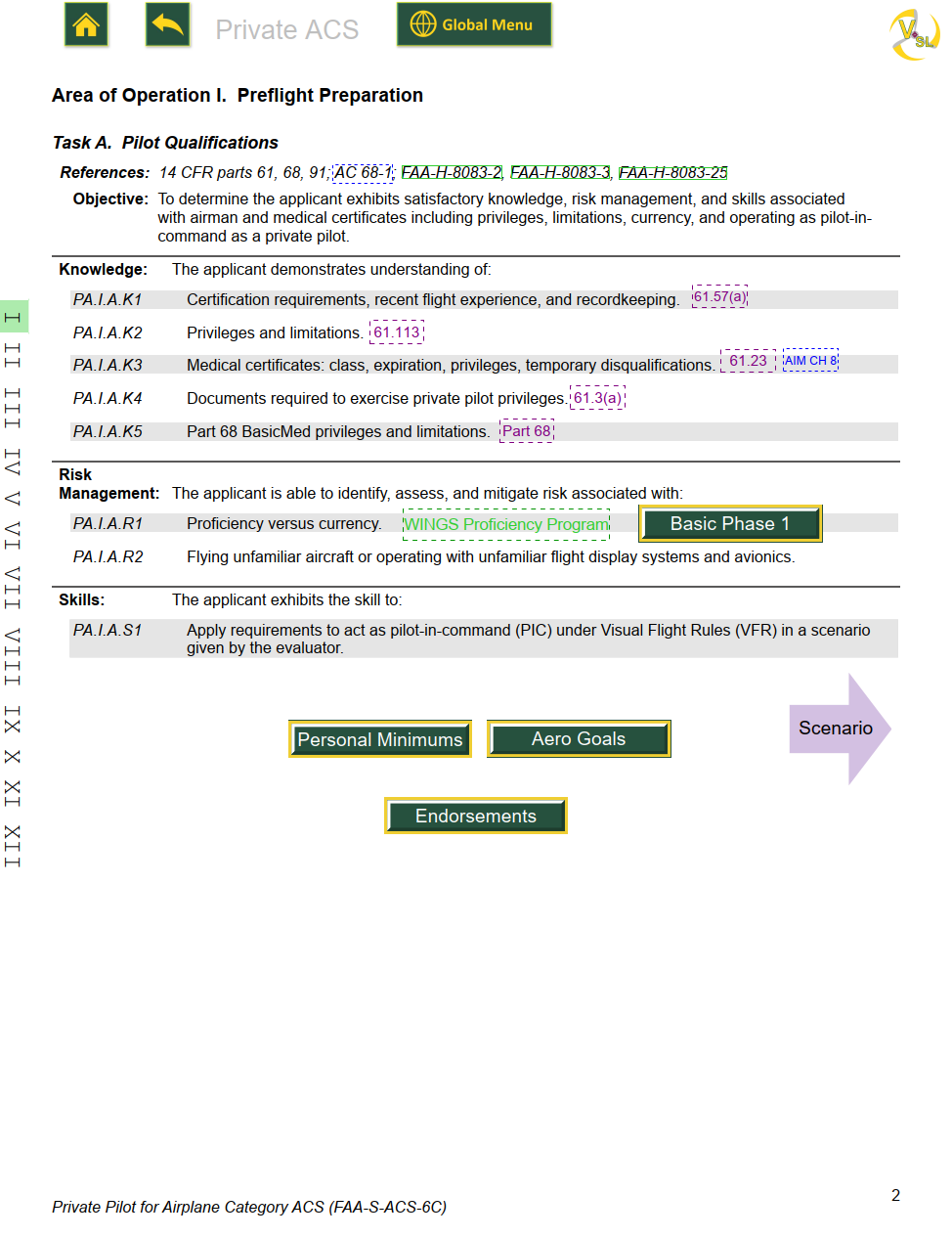
The Private Pilot ACS Task A, Pilot Qualifications page, with hyperlinks to regulations and buttons at the bottom. The link to 14 CFR 61.113 is highlighted.

The task page

Tap Task A and you'll see the ACS Task A page, which includes several hyperlinks and buttons.

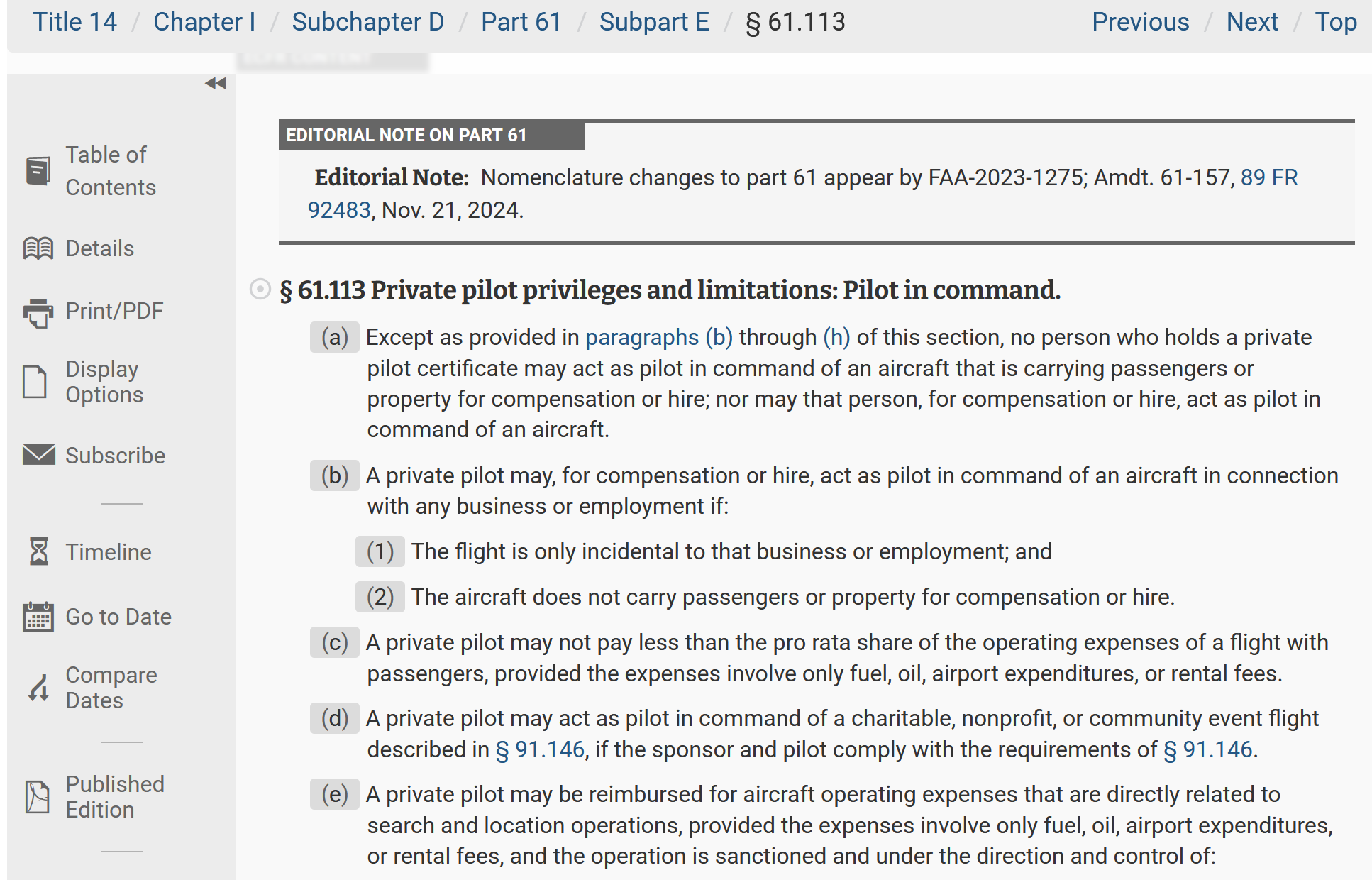
After a quick scan, we can see a link to FAR 61.113, which covers privileges and limitations, along with many other links about pilot qualifications.

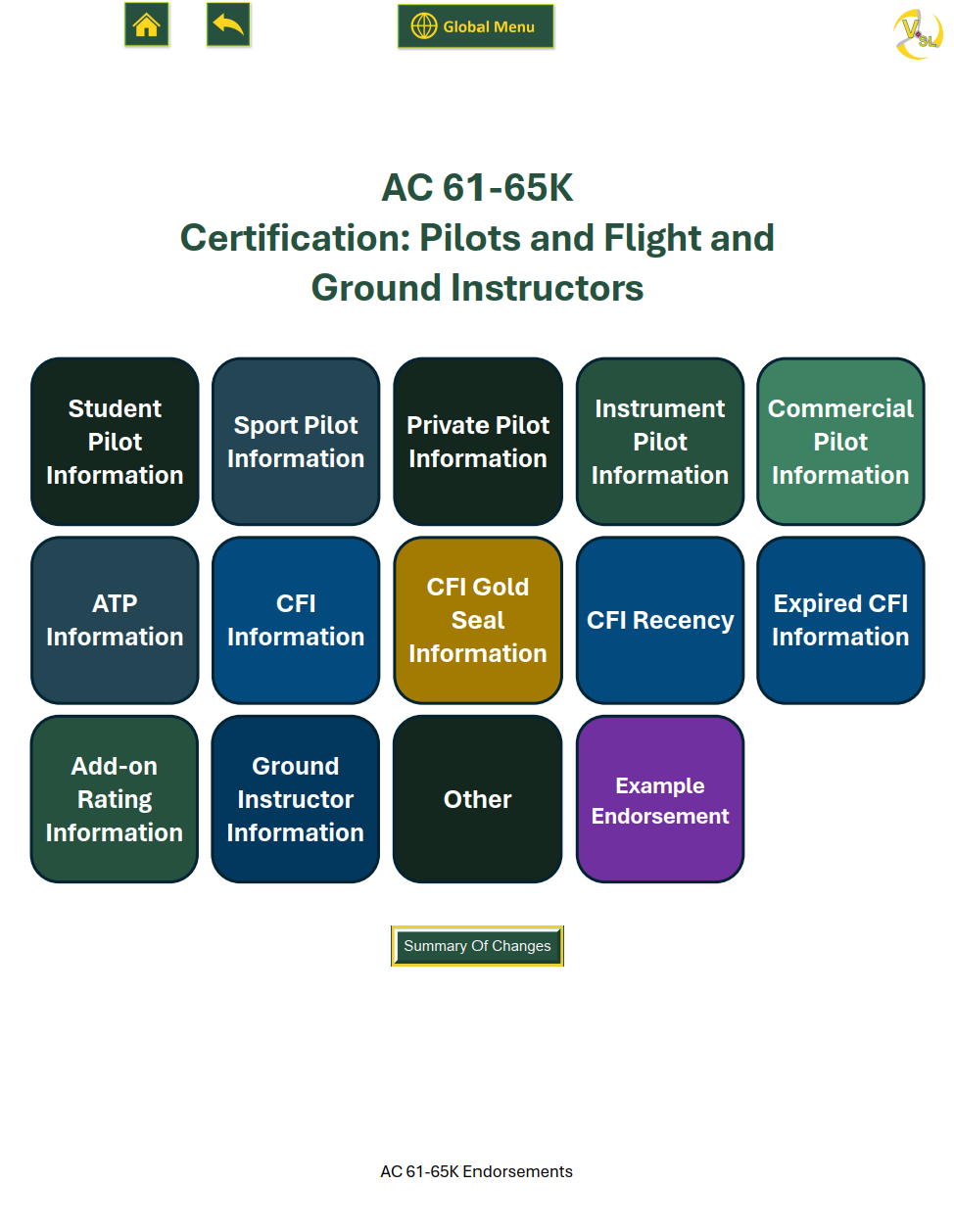
The AC 61-65K page, Certification: Pilots and Flight and Ground Instructors, with the back arrow at the top highlighted

Try it: the Endorsements button

In this example, let's tap the green Endorsements button at the bottom of the Task A page. It takes us to AC 61-65K.

The green Endorsements button

Tap this button at the bottom of the Task A page.

Going back

To return to the page you were just on, tap the back arrow at the top of the page.

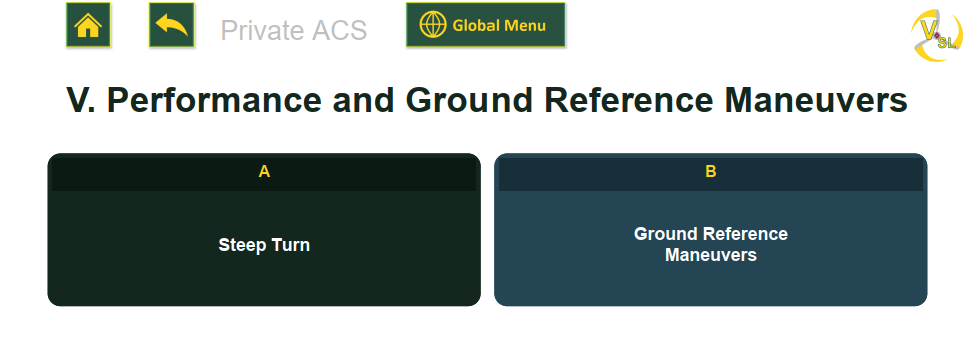
Area of Operation V, Performance and Ground Reference Maneuvers, with the Task A Steep Turn tile highlighted

Studying a maneuver: Steep Turns

Say you want to study a particular maneuver, like the Steep Turn. There are a couple of ways to do it.

The first way is to use the ACS. Navigate to Area of Operation V, then Task A, Steep Turn.

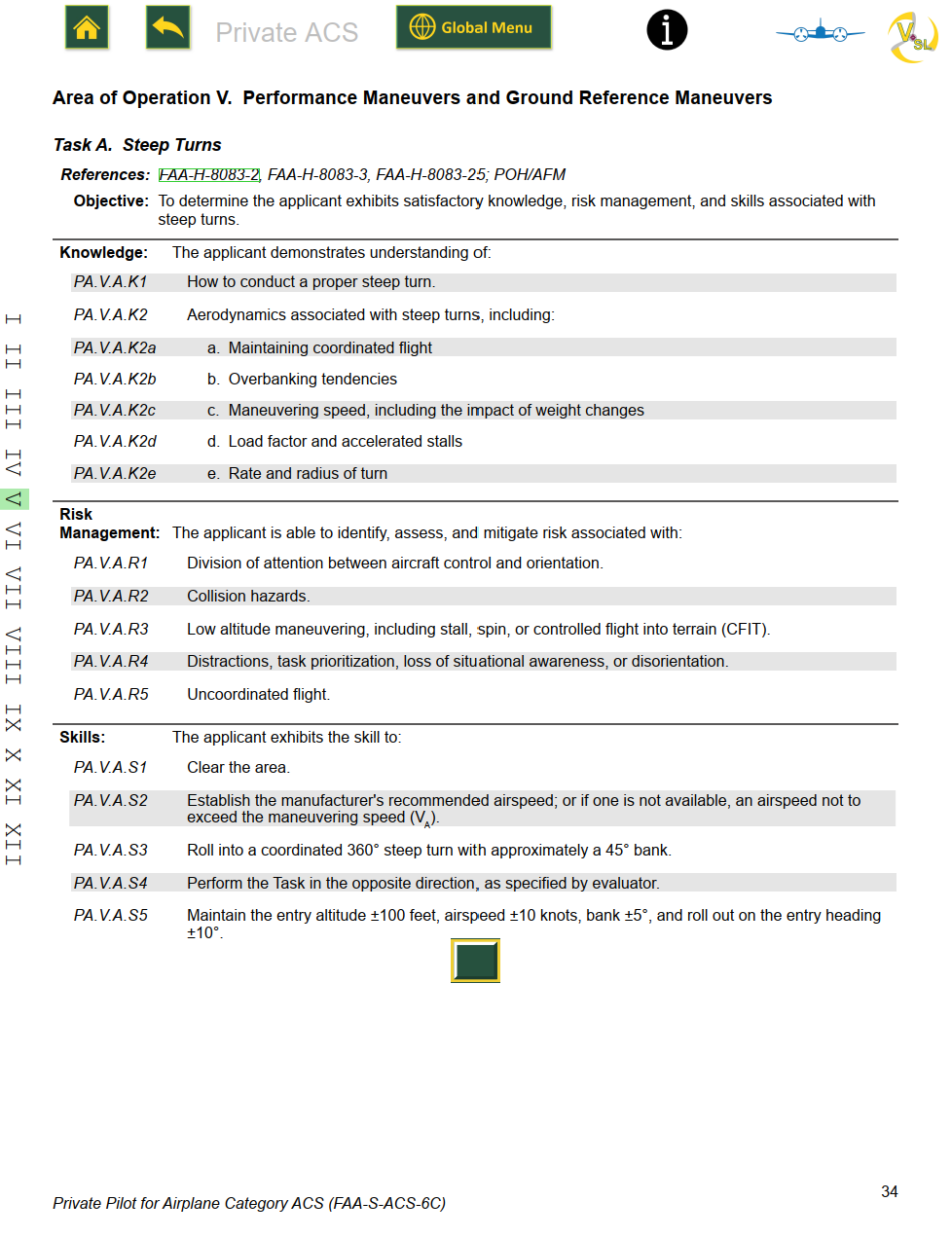
The Private Pilot ACS Task A, Steep Turns page, listing knowledge, risk management, and skill elements, with a green button at the bottom highlighted

The Steep Turn task page

As in the previous example, this takes you to the ACS task page for steep turns. It lists the Knowledge, Risk Management, and Skill elements.

Since this is a flying task, there aren't as many links. Most of the maneuver is covered in the Airplane Flying Handbook.

At the bottom of the page you'll see a single green button. Tap it to go directly to Chapter 10 of the AFH, on the page for Steep Turns.

The green button at the bottom of the Steep Turns task page

This button sits at the bottom of the task page, below the last skill element.

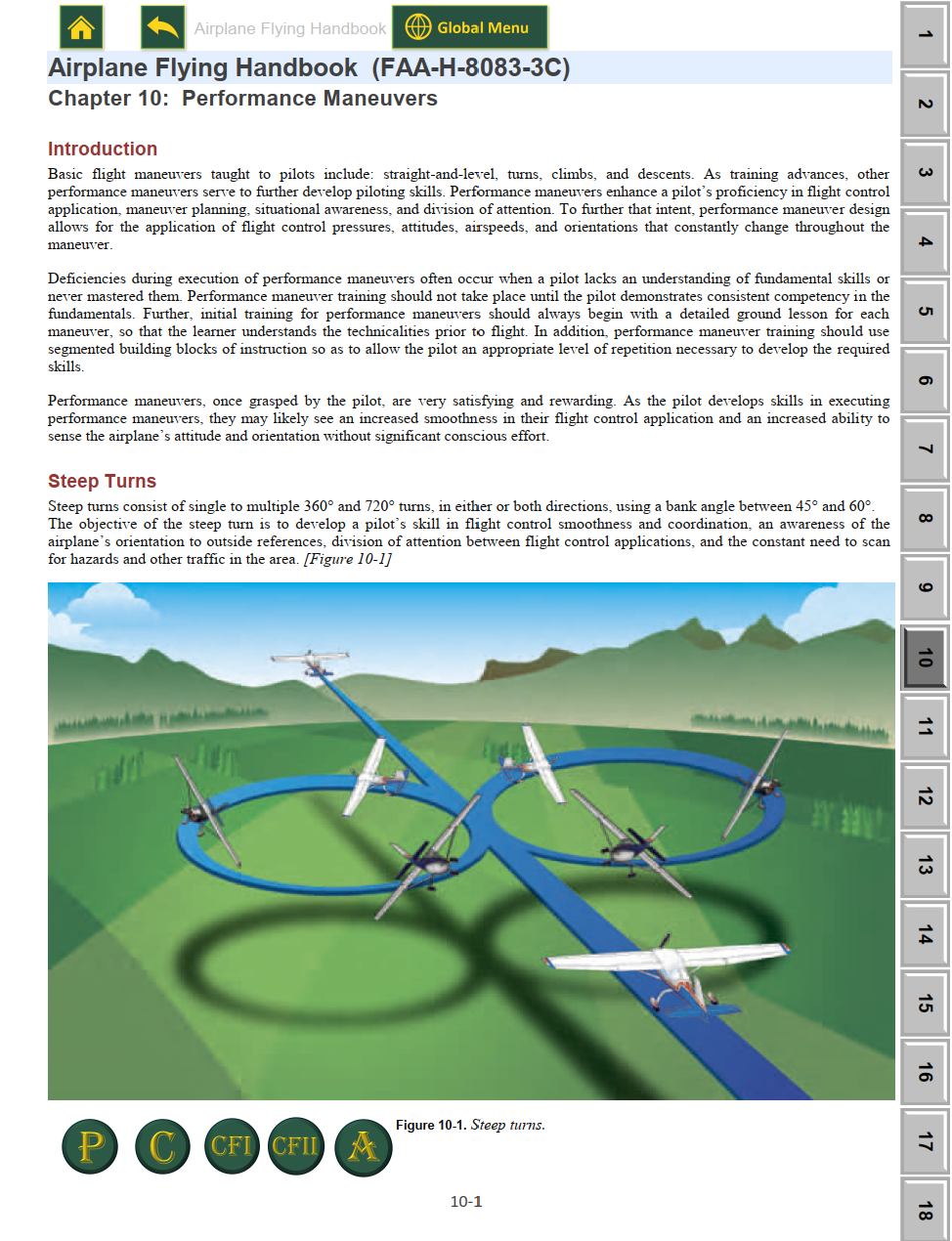
Airplane Flying Handbook Chapter 10, Performance Maneuvers, on the Steep Turns page, with the row of P, C, CFI, CFII, and A buttons highlighted at the bottom

The Airplane Flying Handbook page

You land on the Steep Turns page in Chapter 10 of the Airplane Flying Handbook.

On this page you'll also see buttons that take you back to the Steep Turn task in the other ACS documents, such as Commercial, Instructor, and ATP.

The quick link menu with the Maneuvers button highlighted

The second way: the Maneuvers menu

You can also find a maneuver without going through the ACS.

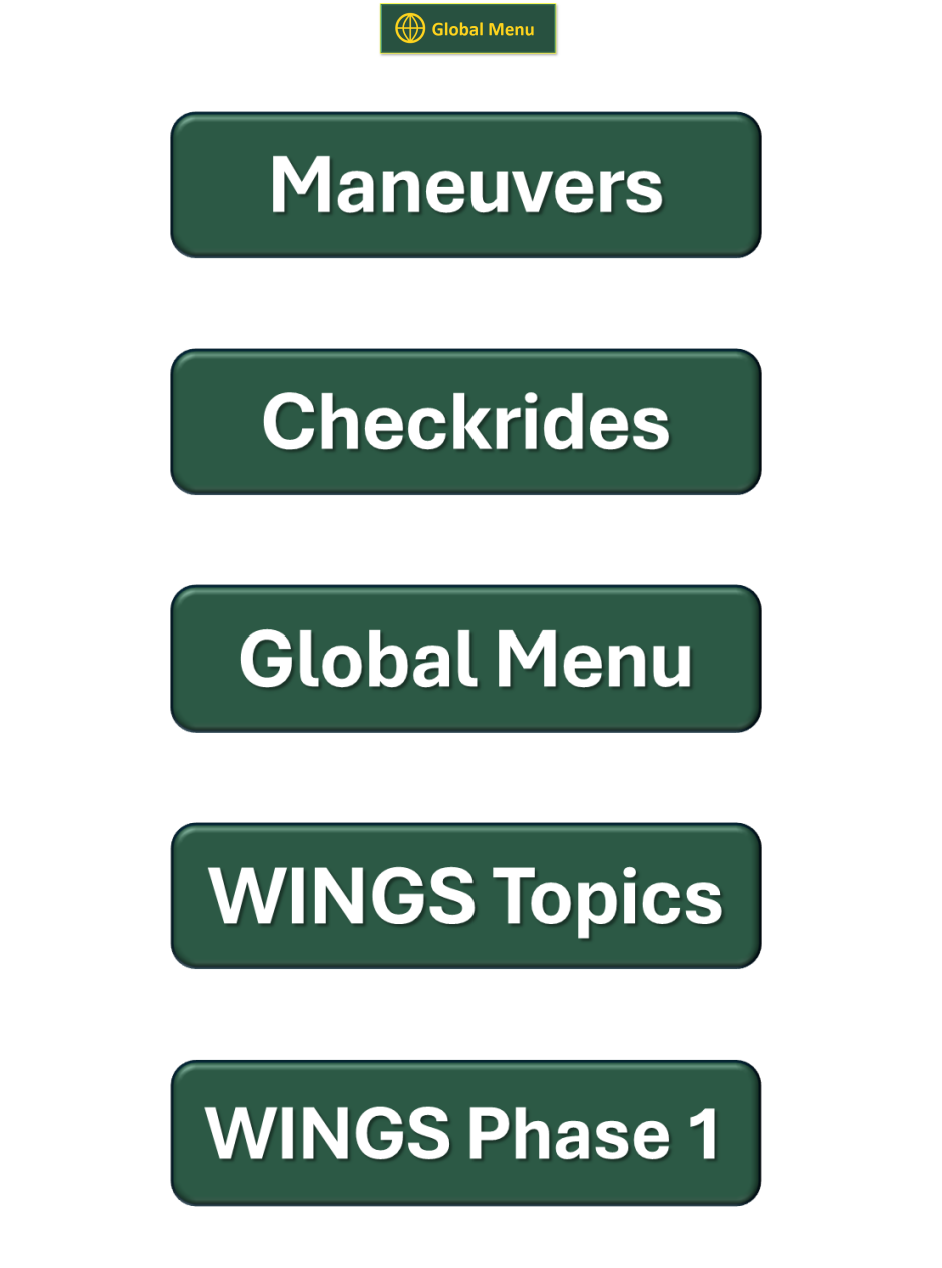
  1. 1 Tap the Global Menu button.
  2. 2 Tap the yellow hamburger button.
  3. 3 Tap the Maneuvers button.
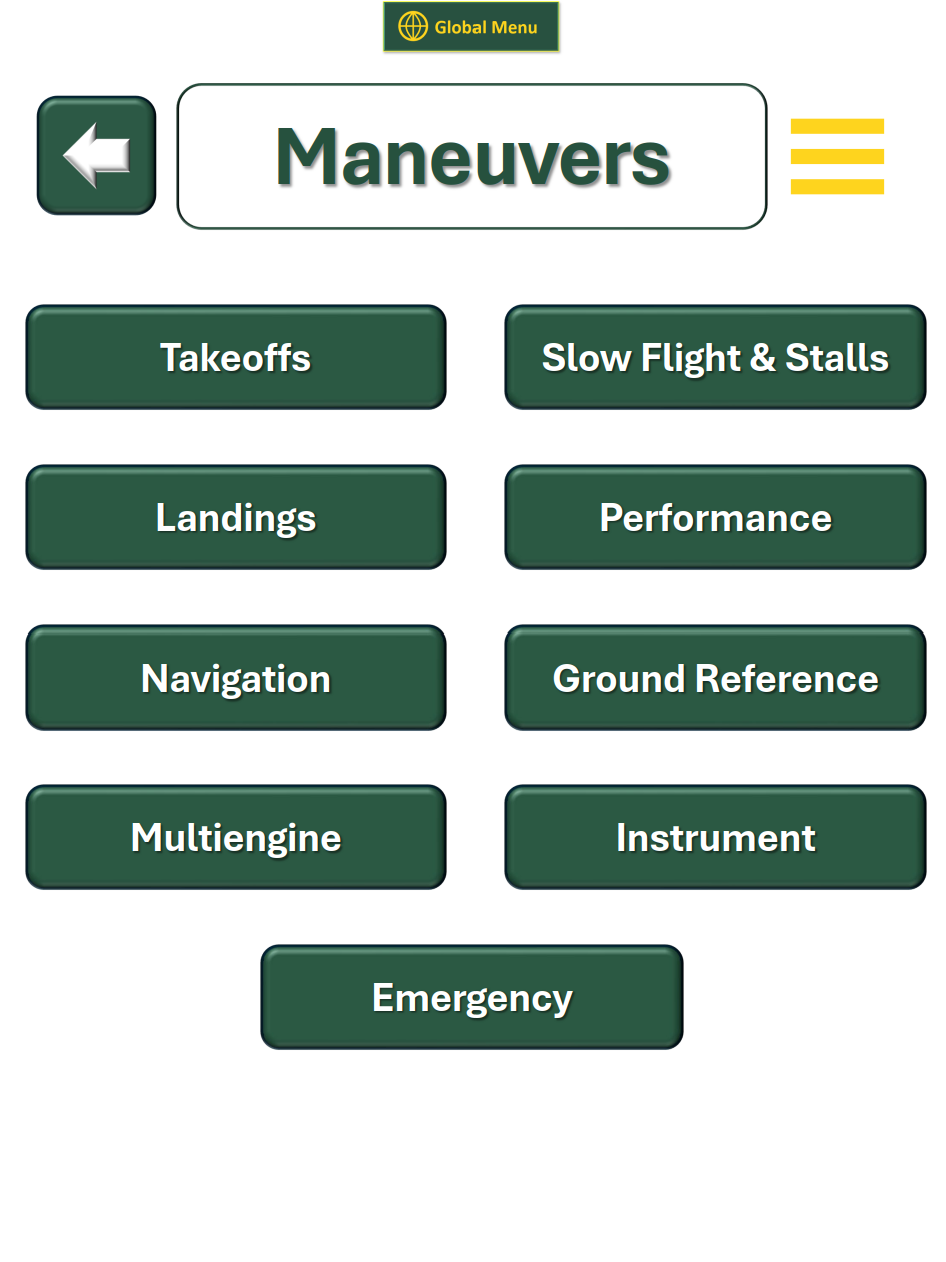
The Maneuvers submenu with buttons for Takeoffs, Slow Flight and Stalls, Landings, Performance, Navigation, Ground Reference, Multiengine, Instrument, and Emergency. The Performance button is highlighted.

The Maneuvers submenu

This takes you to a submenu where you can select from all of the maneuvers covered in the Airplane Flying Handbook.

In this case, tap the Performance button.

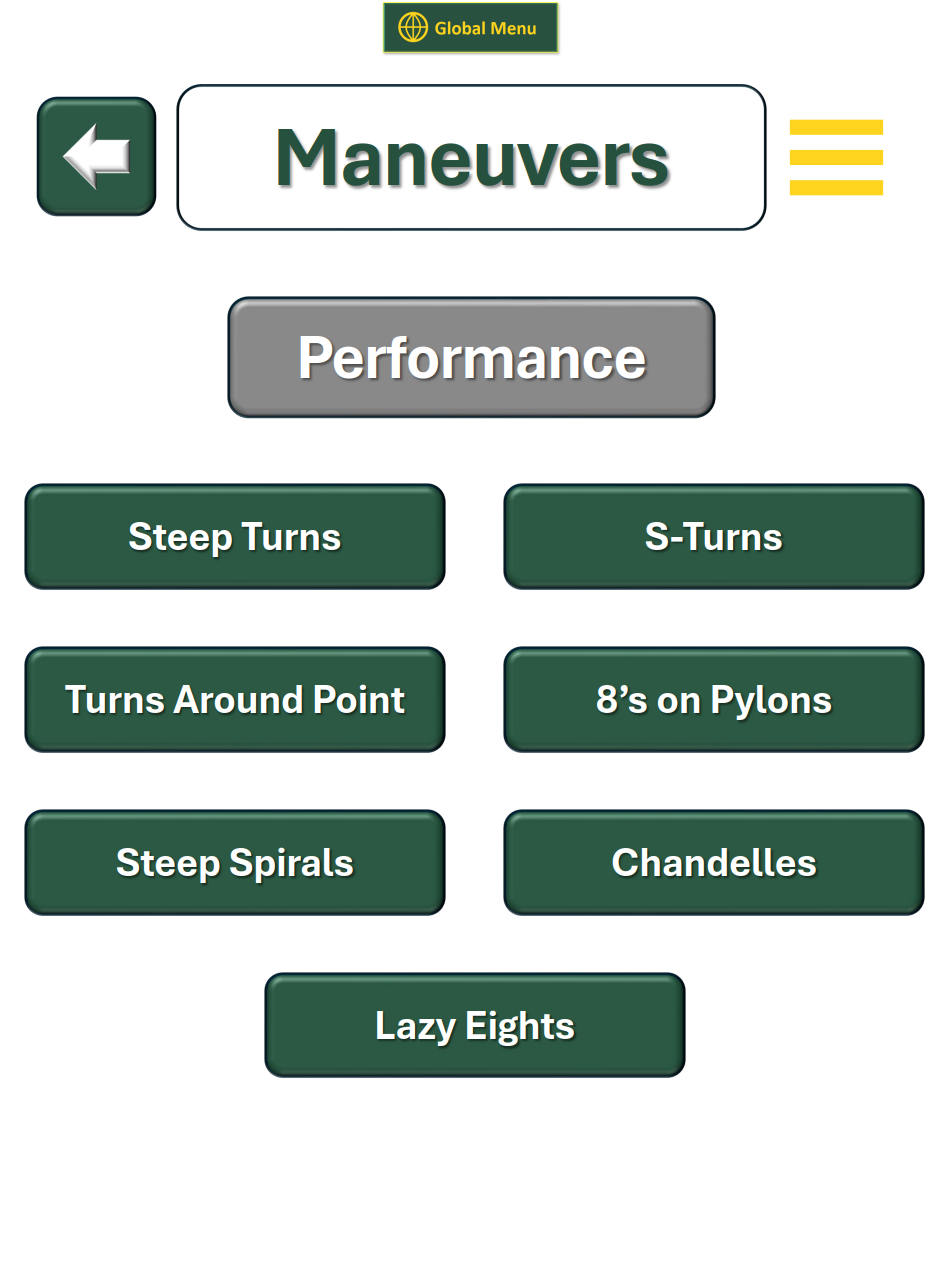
The Performance maneuvers menu with buttons for Steep Turns, S-Turns, Turns Around a Point, 8's on Pylons, Steep Spirals, Chandelles, and Lazy Eights. The Steep Turns button is highlighted.

Pick your maneuver

Now tap the Steep Turns button.

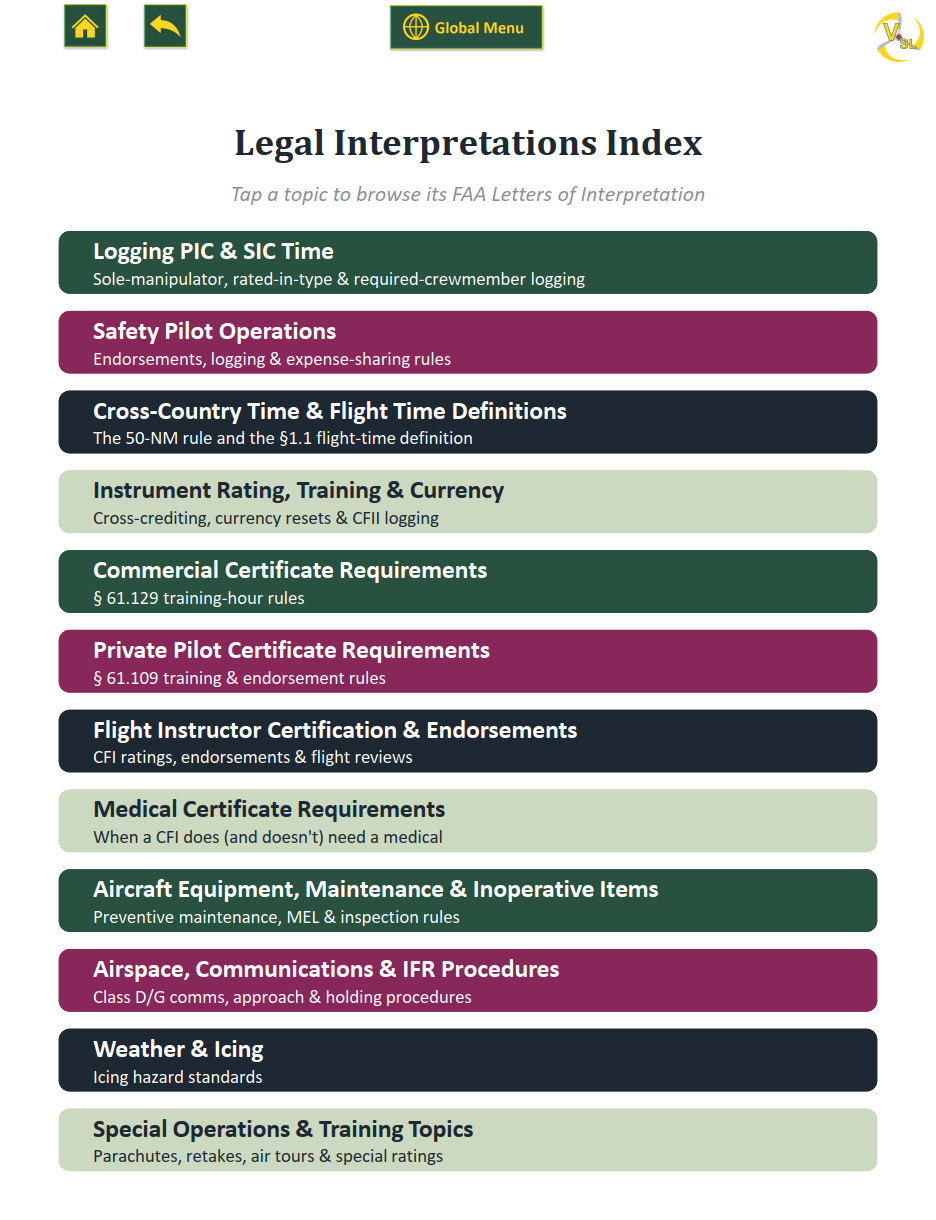
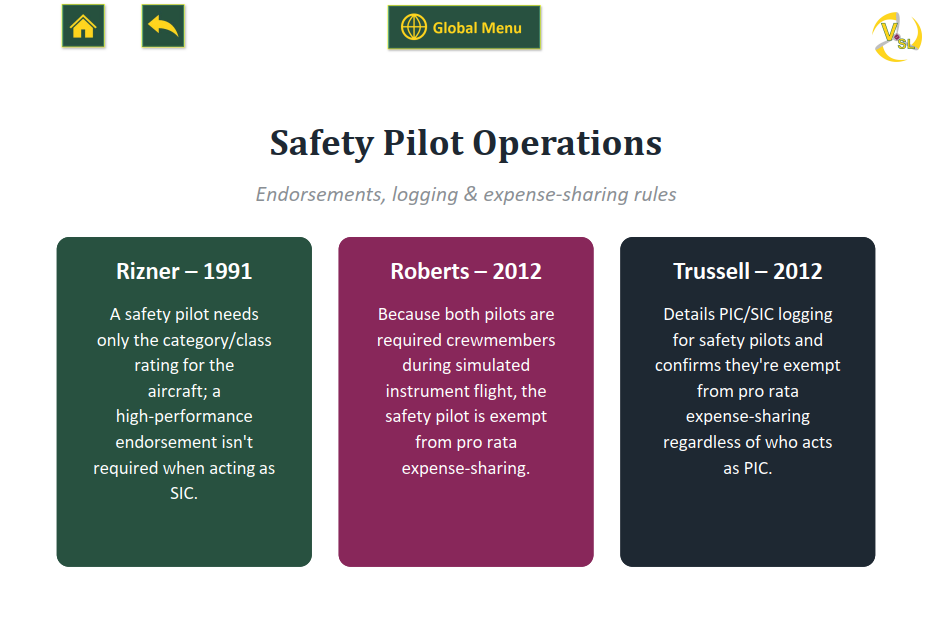
The Safety Pilot Operations submenu with three Letters of Interpretation: Rizner 1991, Roberts 2012, and Trussell 2012, each with a short description. Rizner 1991 is highlighted.

Three letters, short descriptions

This takes you to a submenu with three LOIs and a short description of each.

From these, we can see that the Rizner 1991 LOI addresses our question. Tap that button.

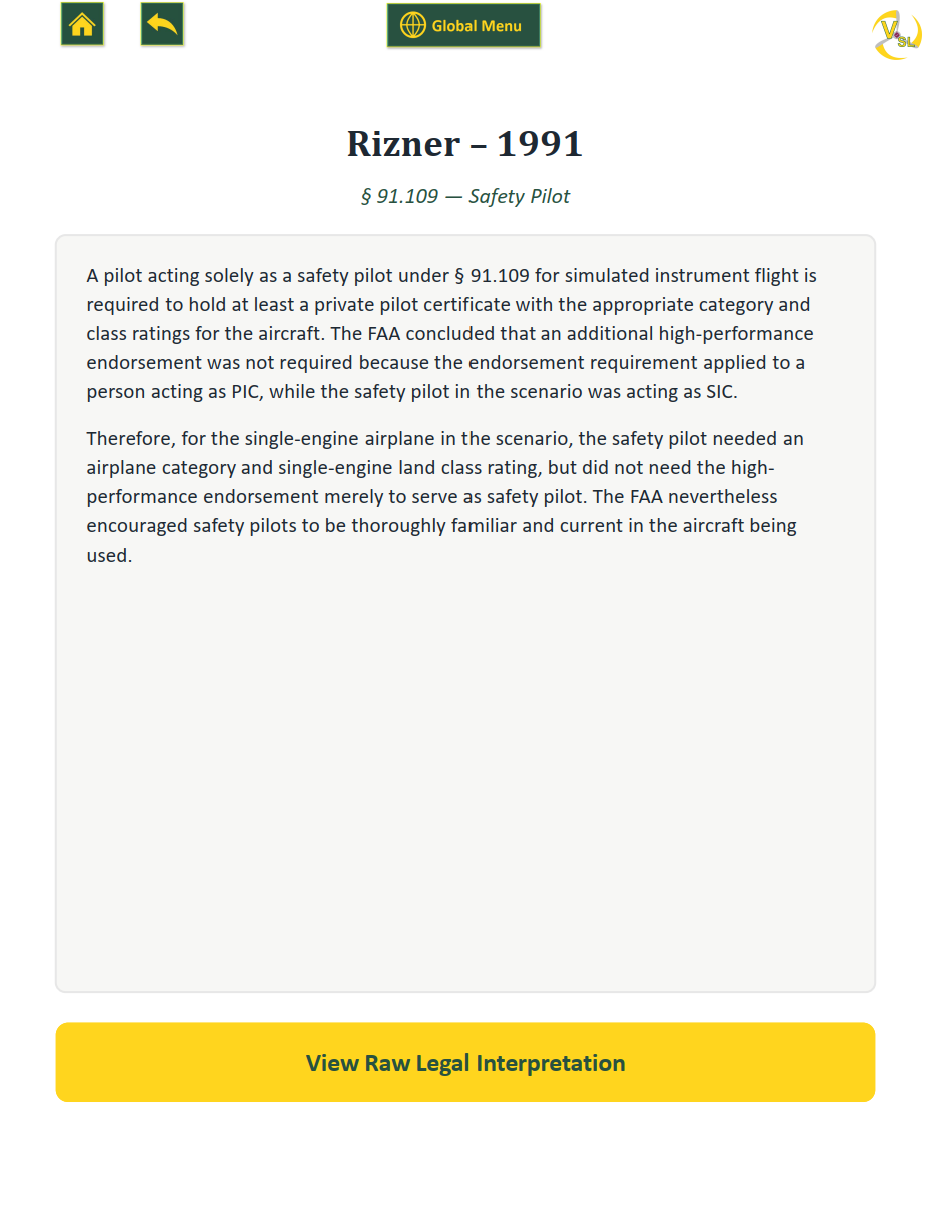
The Rizner 1991 summary page with a short explanation of the interpretation and a View Raw Legal Interpretation button at the bottom

The LOI summary

Tapping the button takes you to the Rizner LOI summary.

At the bottom of the page is a View Raw Legal Interpretation button that takes you directly to the raw LOI.

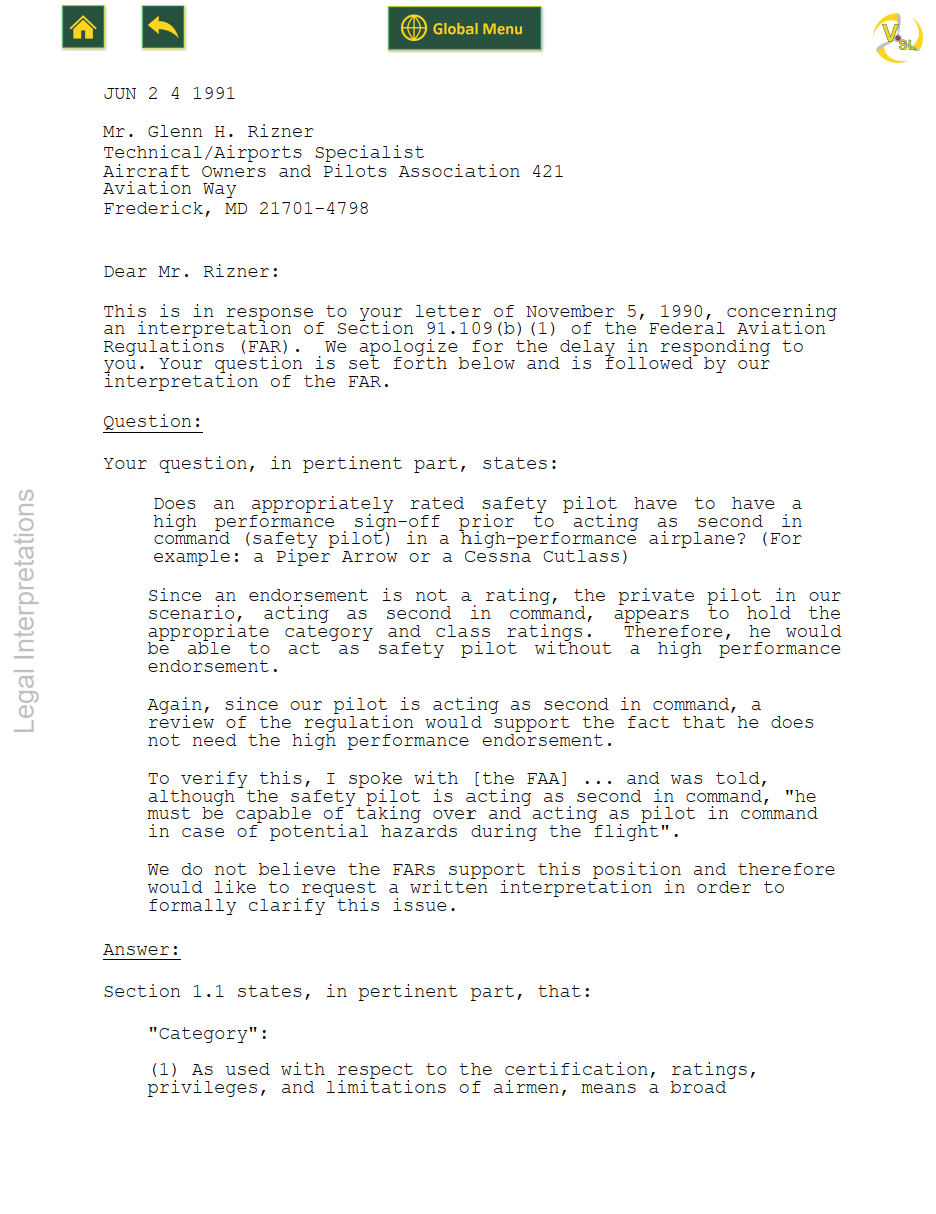
The raw FAA Letter of Interpretation to Mr. Rizner dated June 24, 1991, about Section 91.109(b)(1)

The raw LOI

Here's the original FAA letter, so you can read the exact question and the FAA's answer.

Global Menu page 2 with the NTSB Safety Alerts button highlighted

Finding a case study: NTSB Safety Alerts

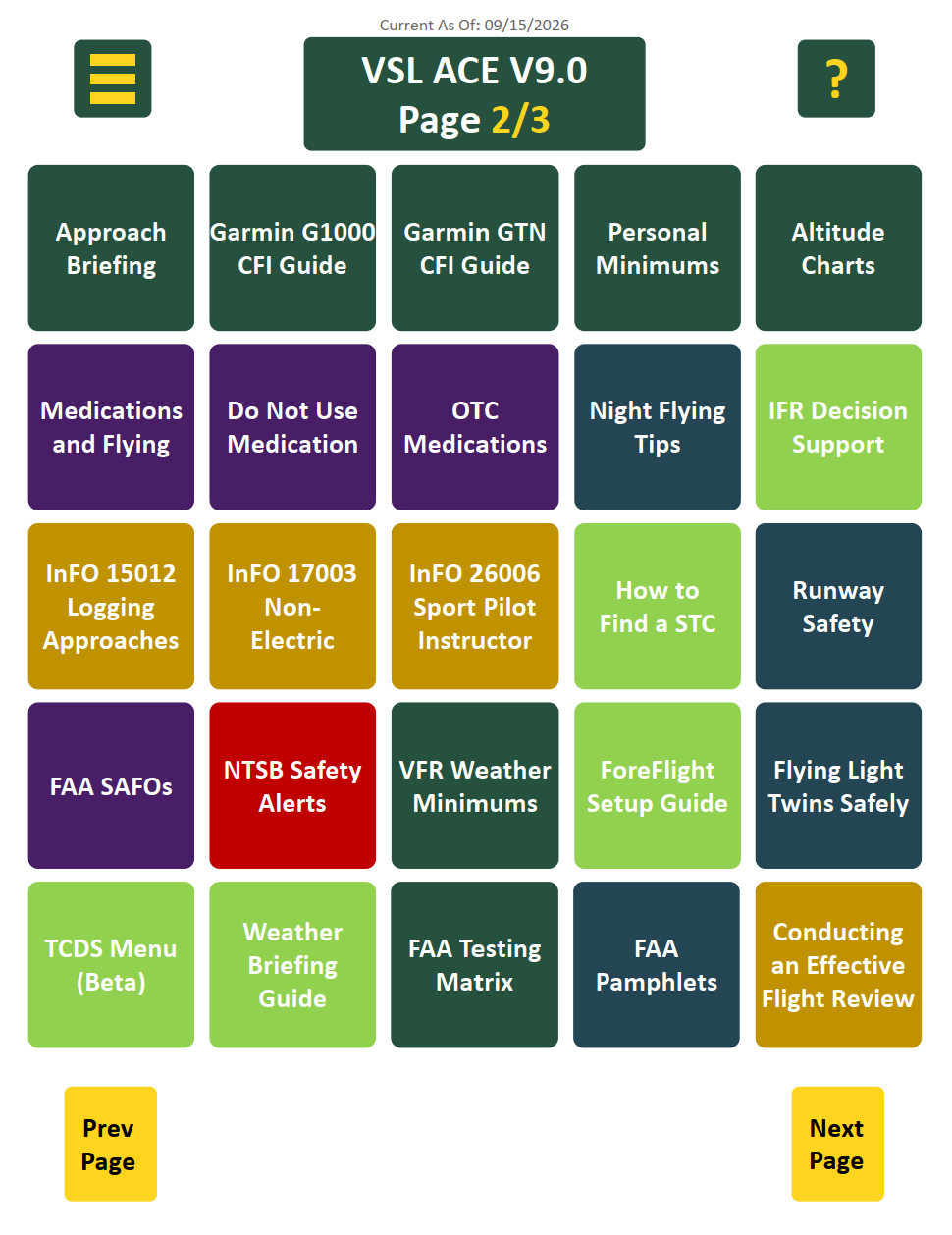
Now let's look at the NTSB Safety Alert section of the ACE Guide. You'll find it on Global Menu page 2.

For this example, say you're a flight instructor preparing a ground lesson on stabilized approaches and you want a good case study to look at.

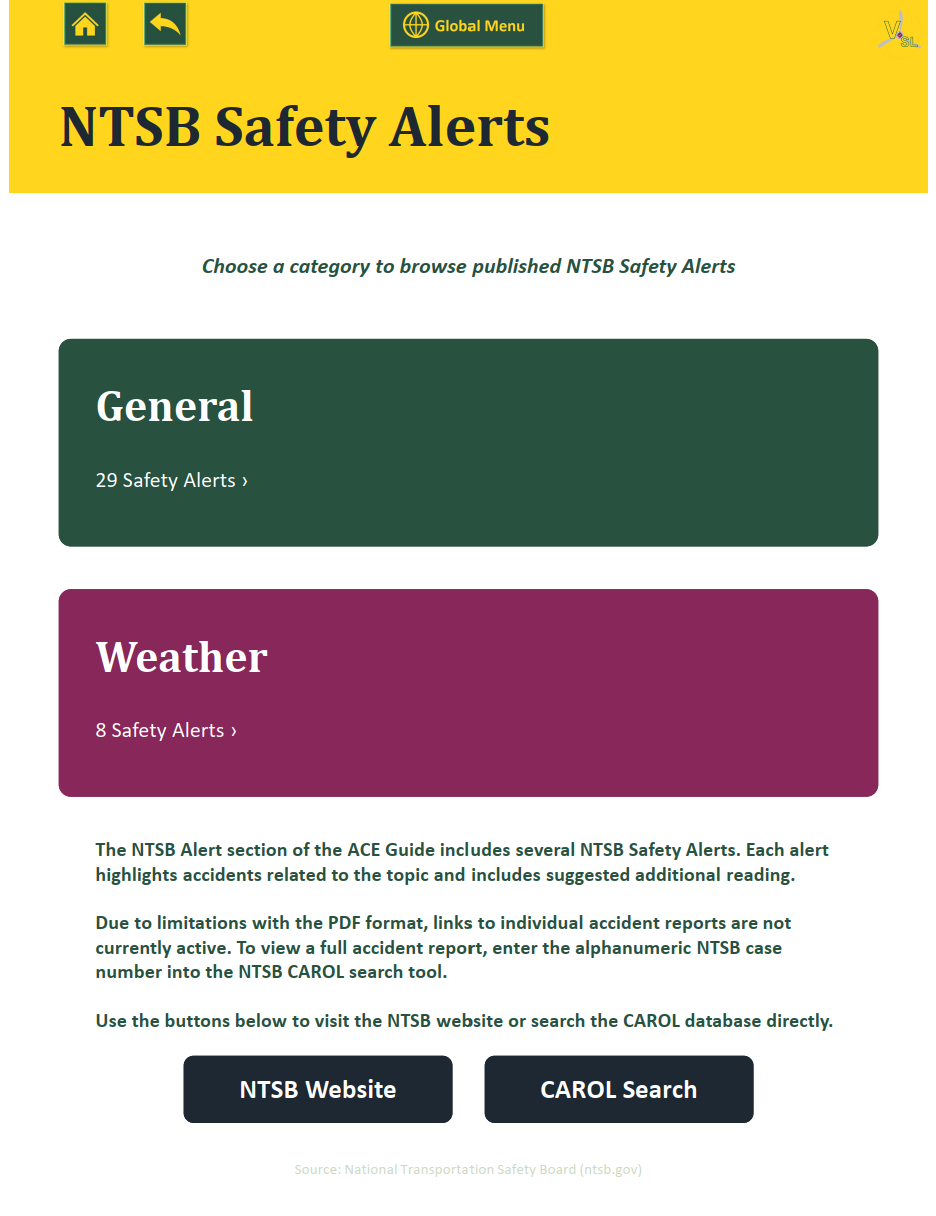
The NTSB Safety Alerts landing page with a General category of 29 alerts and a Weather category of 8 alerts. The General button is highlighted.

General or Weather

After tapping the NTSB Safety Alerts button, you'll see two options: General and Weather.

Tap General.

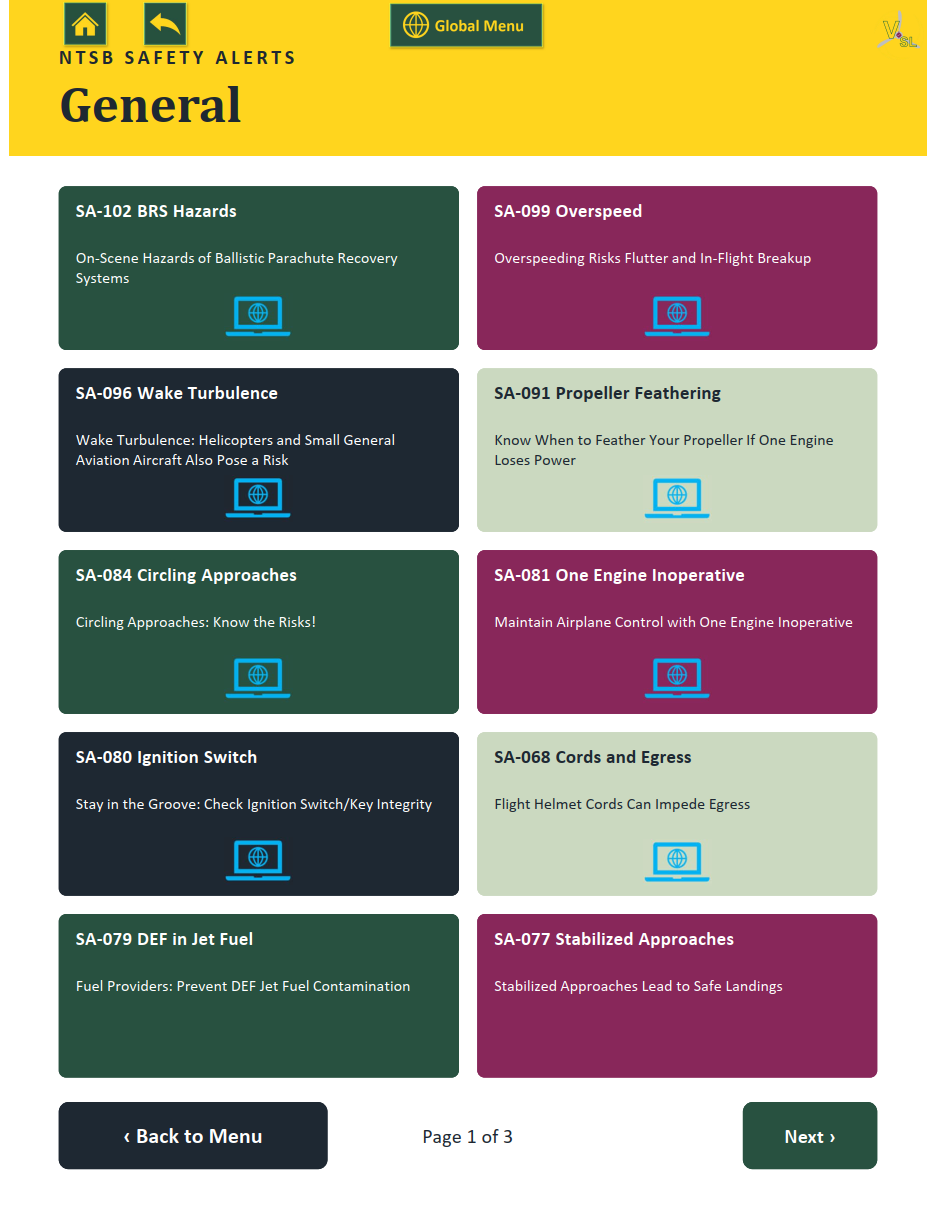
Page 1 of 3 of the General NTSB Safety Alerts menu, listing alerts with short descriptions. The SA-077 Stabilized Approaches card at the bottom right is highlighted.

Browse the safety alerts

Next you'll see a three-page menu of safety alerts with brief descriptions.

If a card has a blue computer icon, it needs an internet connection. In our example, the card at the bottom right of this page is SA-077 Stabilized Approaches, and it is saved locally in the guide.

The blue computer icon

A blue computer icon means the alert opens online and needs an internet connection.

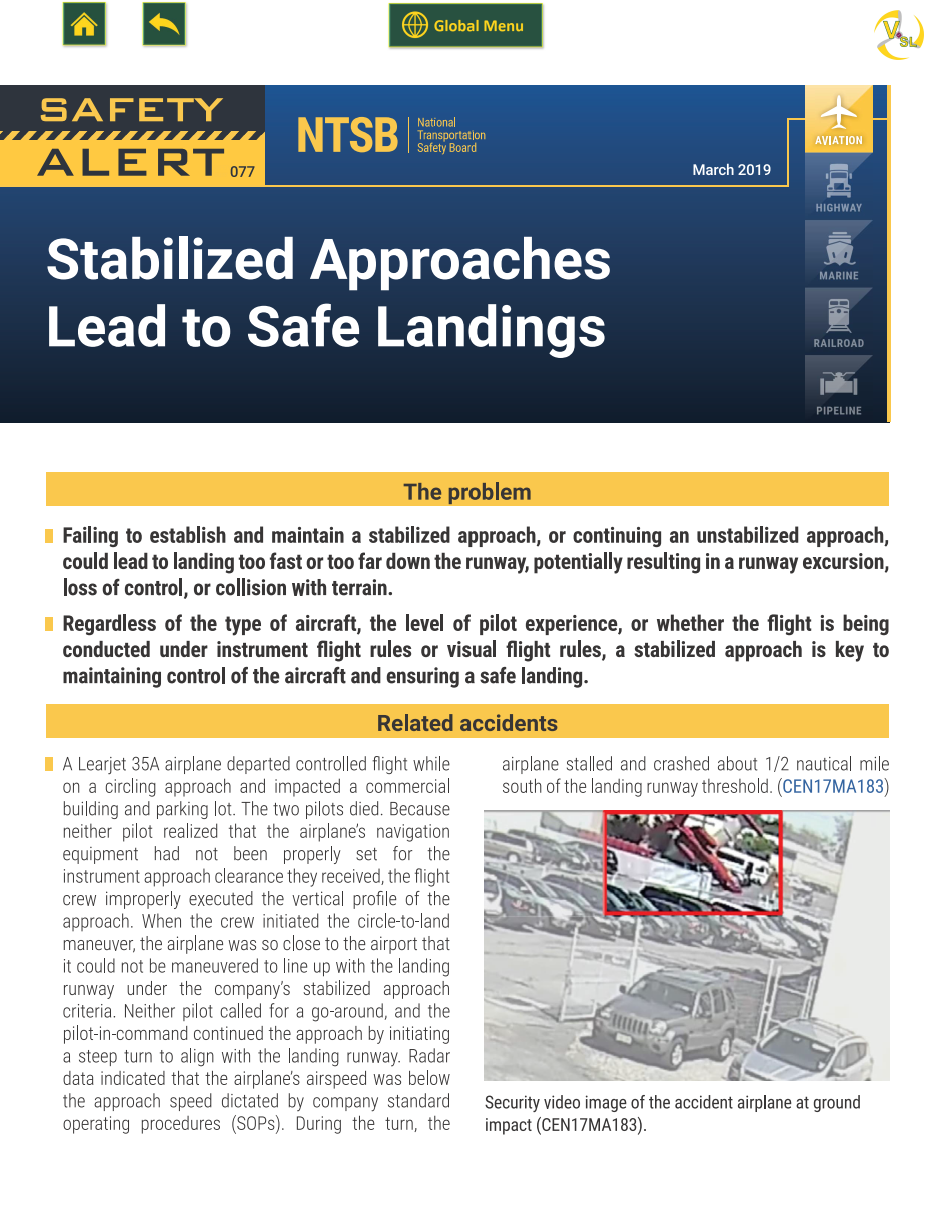
NTSB Safety Alert 077, Stabilized Approaches Lead to Safe Landings, showing The problem and Related accidents sections

The safety alert

Tapping that card takes you to SA-077, which covers stabilized approaches.

Each alert describes the problem and lists related accidents.

Find a case study

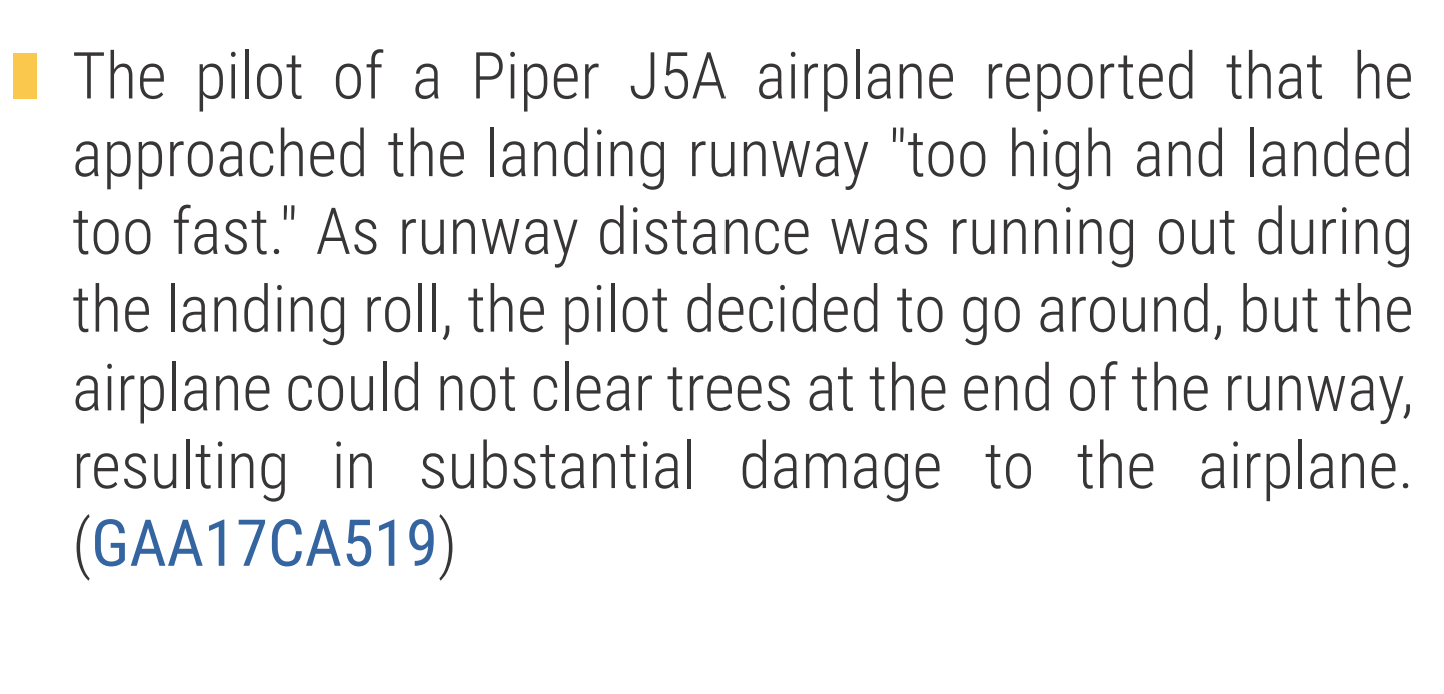
On page 2 of the safety alert, we find an accident involving a Piper J5A. It includes the NTSB investigation number.

To look it up, we'll use that number, GAA17CA519.

An excerpt from the safety alert describing a Piper J5A that landed too high and too fast and could not clear trees on a go-around, with the NTSB number GAA17CA519 highlighted
The NTSB Safety Alerts landing page with the CAROL Search button highlighted

Looking up the accident

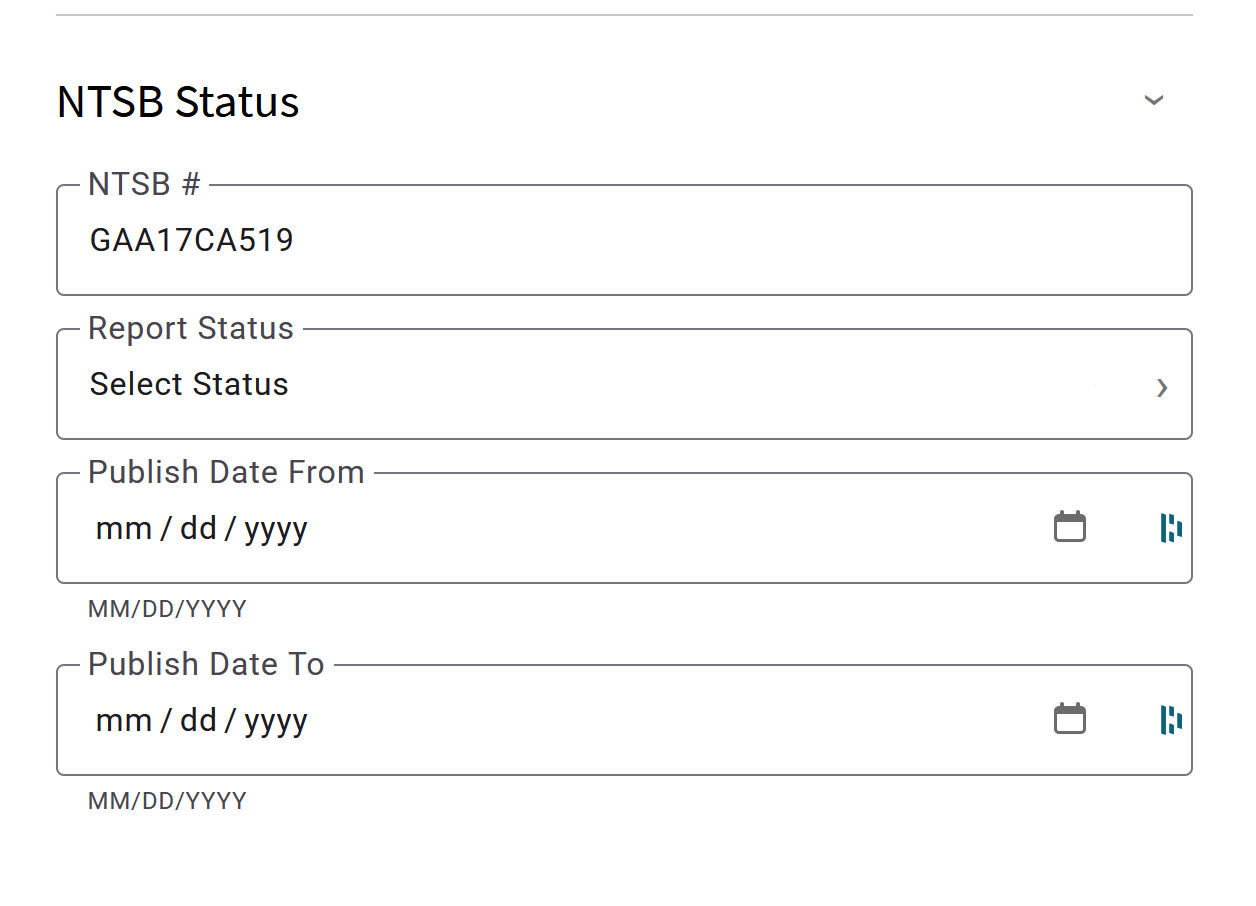
To look it up, tap the home button at the top of the page. This takes you back to the NTSB Safety Alert landing page, which has a link to the NTSB CAROL search portal.

The home button, a small house icon

The home button is the small house at the top of the page.

Tap CAROL Search to open the website.

Internet connection required. The landing page also explains that links to individual accident reports aren't active in the guide, so you look up the case number in CAROL instead.

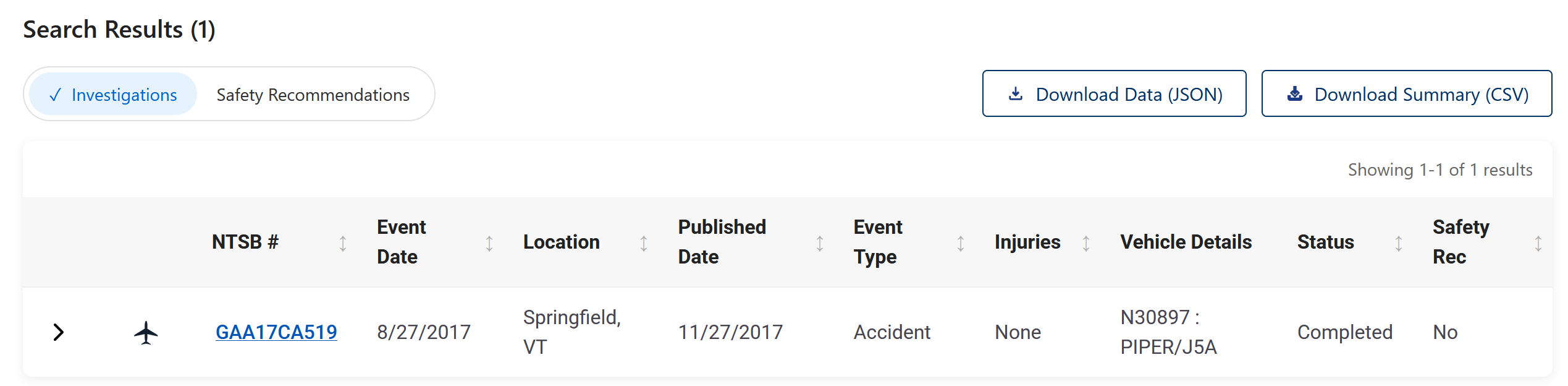
The search results

The search results let you open the full investigation page on the NTSB website. Tap the case number to open it.

CAROL search results showing one investigation, GAA17CA519, with its event date, location, and vehicle details. The case number link is highlighted.

The full investigation

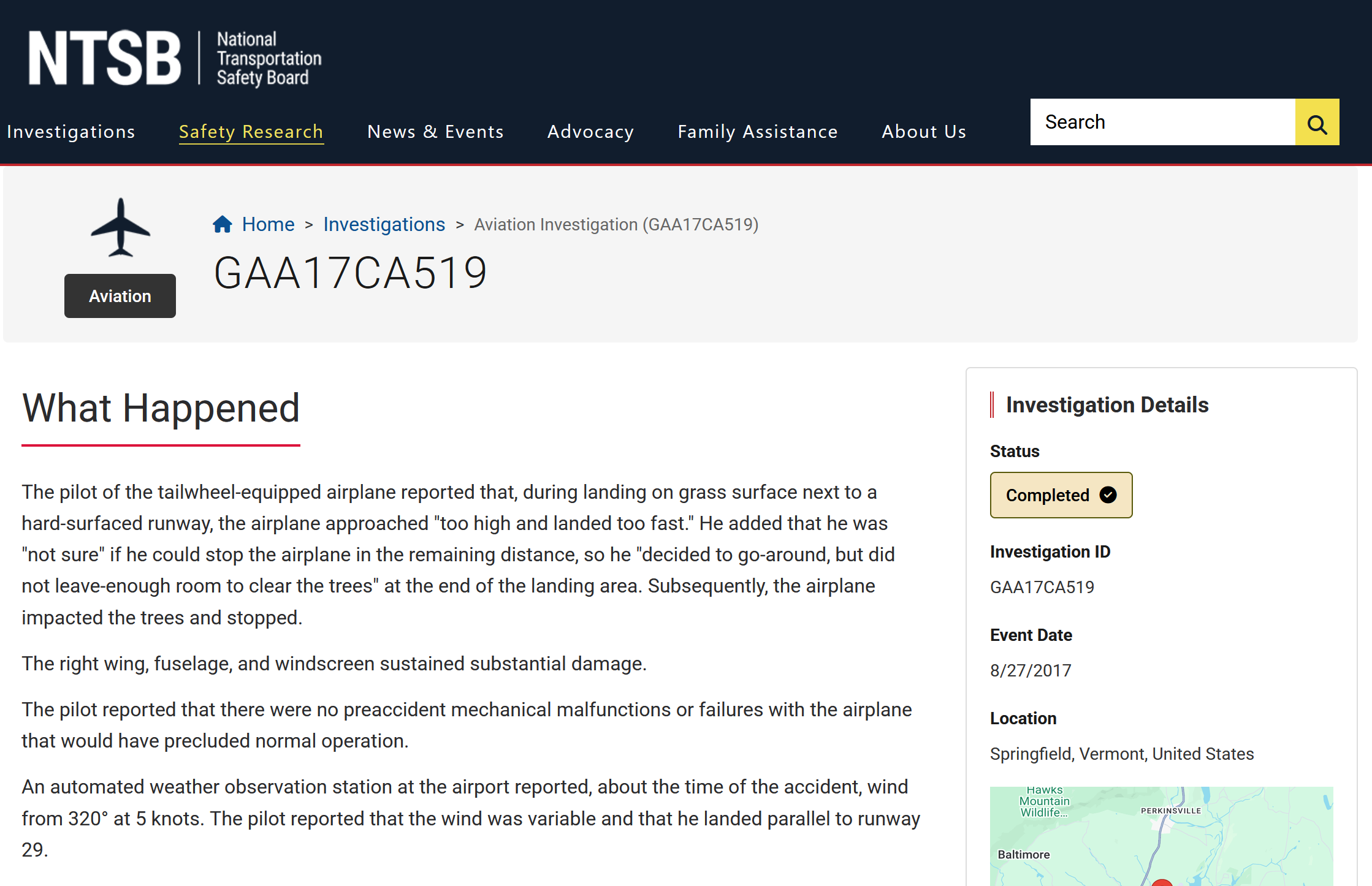
Here's the full investigation page on the NTSB site, for your reference and use. It's a good case study to bring to a stabilized approach lesson.

The NTSB investigation page for GAA17CA519, with the What Happened summary and an Investigation Details panel

Explore the guide

The ACE Guide currently has over 7,000 pages of information. That can feel overwhelming, but don't think of it as a whole document you need to read. Think of it as a system that helps you find information quickly, when you need it. Tap around and explore the different navigation menus. I guarantee you'll find FAA information you didn't even know existed.

That's one of the reasons we created this guide. FAA information can be difficult to find because it's spread out over dozens of websites. Many handbooks, advisory circulars, and pamphlets with important information are hardly known because they're stored on some obscure FAA website. And that's not even counting the legal interpretations, NTSB alerts, and other esoteric documents that a lot of pilots wouldn't know to search for.

We're constantly looking for useful documents to add to the guide, and we keep improving the link structure to make cross-referencing better. If there's something you'd like to see in a future update, feel free to contact Seth directly at sethlake@vsl.aero.